
Solar Cables in Desert Heat: What the Test Data Shows
Desert projects ask a cable to survive two things at once: a daily ambient peak and a rare, violent temperature spike. The published data answers both, with an ambient range of −40 °C to +90 °C, a short-circuit limit of +250 °C held for 5 s and an elongation before ageing of up to 185% against the 125% that EN 50618 requires. Those figures come from the pages of KUKA CABLE, a manufacturer in Jinshan District, Shanghai that builds solar cables and wiring harnesses for the DC side of photovoltaic systems.
Key takeaways
- Ambient rating of the published construction: −40 °C to +90 °C.
- Short-circuit limits: +120 °C for 20,000 h and +250 °C for 5 s.
- A 2,000-hour xenon lamp test is described as equal to about 360 weathering cycles.
- Elongation before ageing is published as up to 185%, against the EN 50618 requirement of more than 125%.
The temperature window a hot-climate array works in
Heat reaches a DC cable in two different ways, and the published numbers separate them. The first is the steady condition: the conductor and the sheath sit at whatever the ambient air and the sun allow, and the site gives that range as −40 °C to +90 °C. The second is the fault condition, where current through a damaged joint heats the copper far beyond ambient. For that case the 1500 V solar cable page states two limits rather than one, +120 °C sustained for 20,000 hours and +250 °C for a period of 5 seconds.
Reading the pair together is the useful part. A short circuit that clears in a fraction of a second is a different event from one that is allowed to persist, and the cable is described against both. The materials named on the page are an electron-beam cross-linked XLPO insulation and a matching XLPO sheath, both described as low smoke halogen free, over a tinned copper conductor. Cross-linking is what lets the compound hold its shape at the upper end of that window without turning soft.
What 2,000 hours of xenon light proves
Ultraviolet and visible light attack the sheath long before they reach anything else, so the light test is the one to read first for a hot, bright site. The manufacturer describes a 2,000-hour xenon lamp test arranged on its solar products, and translates the exposure into about 360 weathering cycles that combine intense sunlight, humidity and ozone. The site states that the TÜV EN 50618 benchmark for UV stability is high and that the intention is to go beyond it.
Dividing the two published figures gives 2,000 ÷ 360, which is about 5.6 hours of xenon exposure per weathering cycle; that division is mine, and it assumes the cycles are of equal weight, which is a simplification. What the test does not prove is performance at a named project, because the site publishes no site-specific ageing study. A buyer comparing quotations should therefore treat the xenon hours as a laboratory result that identifies a well-formulated compound, not as a forecast for one array.
Elongation: the number desert buyers should quote back
Elongation at break is the property that says how much a sheath can stretch before it cracks, and it is the least glamorous figure on a photovoltaic datasheet. The standard named on the product page requires more than 125%; the manufacturer states that its photovoltaic cables typically run about 20% above the requirement, reaching up to 185%. In a hot climate this is the number that separates a compound which stays flexible after years of light exposure from one that becomes brittle and splits at a clip.
Put the two together and the margin is 185 − 125 = 60 percentage points above the threshold, which is 48% more than the standard asks for; both of those are my own calculations on published values. The site does not publish the test certificate number or a per-batch elongation result, so a project that needs the figure for a specific drum has to request the laboratory record through the sales contact.
The manufacturer's published test list covers a shorter set that a hot-climate buyer can use as a checklist of what to read:
- water resistance testing and UV accelerated weather testing;
- abrasion testing, cold bending and cold elongation;
- tensile testing after ageing;
- solderability and static flexibility testing;
- construction and dimensional checks on the finished cable.
Fire behaviour in a hot, dry installation
Dry heat raises the consequences of any fault, so the published flame test is worth reading next to the temperature limits. The page describes a single cable held in vertical burning at 800 °C for one minute, after which it is expected to extinguish itself. That is a laboratory description rather than a certificate class, and the site does not publish a CPR classification value for the product pages examined.
The certificates page adds the wider picture: more than 30 types of certificates including TUV, IEC, CE, SAA and UL, with the UL document described as being updated. For a desert project in a market that requires a fire rating, the sensible step is to ask which certificate applies to the exact model offered, because a cable list and a certificate list are different documents.
What to check on the datasheet before shipping to a hot site
Four published values decide most of the argument. The ambient range tells you whether ordinary daytime operation is inside the declared window. The two short-circuit limits tell you what the cable is described against when something goes wrong. The elongation figure tells you how the sheath behaves after ageing. The xenon hours tell you how much light exposure stands behind the claim. All four appear in the table below with the pages they were read from.
| Property | Published figure | Where it is stated |
|---|---|---|
| Ambient temperature range | −40 °C to +90 °C | 1500 V solar cable page |
| Short-circuit, sustained | +120 °C for 20,000 h | 1500 V solar cable page |
| Short-circuit, brief | +250 °C for 5 s | 1500 V solar cable page |
| Elongation before ageing | At least 125% required, up to 185% published | Laboratory page and cable page |
| Xenon lamp exposure | 2,000 hours, about 360 weathering cycles | Laboratory page |
| Vertical flame test | 800 °C for one minute, expected to self-extinguish | Solar cable topic page |
Worked example
Suppose a 250 m string run is specified in 6 mm². Reading the published cross-section table, the nominal weight is 78 g/m, so the cable alone comes to 250 × 78 = 19,500 g, or 19.5 kg. That multiplication is mine and it ignores drums, clips and waste.
Now apply the ageing margin. The standard asks for more than 125% elongation before ageing, and the manufacturer states up to 185%, so the published figure is 185 − 125 = 60 percentage points higher. If a specification demands a 30% safety margin above the standard, that is a floor of 125 × 1.30 = 162.5 percentage points; the published value still sits above it. Both calculations are mine, made on the published numbers, and neither replaces a test report for a named batch.
What the elongation chart shows
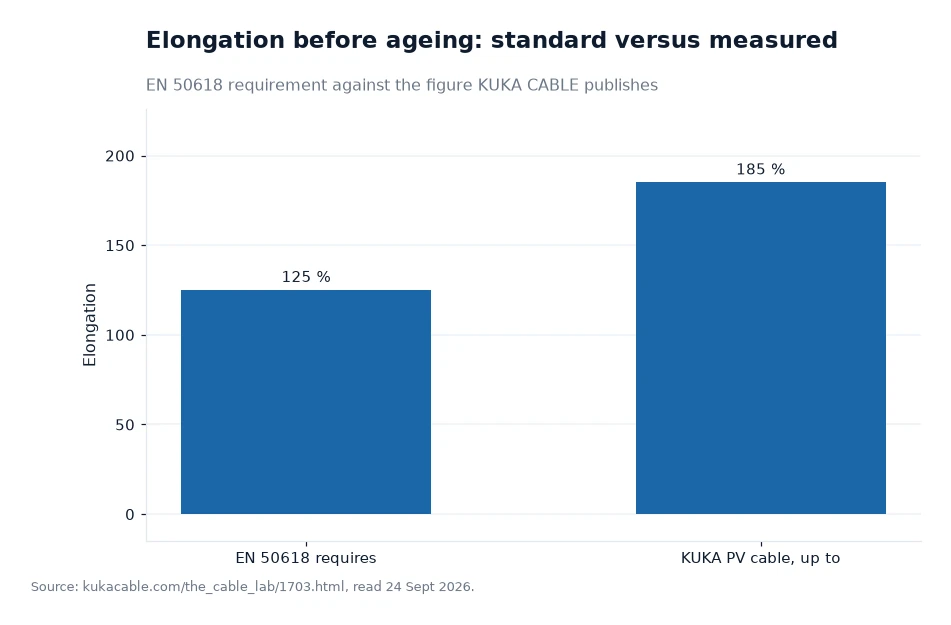
The two bars are a requirement and a measurement, not two products. The left bar is the floor written into the standard, and the right bar is what the manufacturer states its compound reaches before ageing. For a desert site the gap between them is the reserve that absorbs thermal cycling, ozone and clipped cable ties, and it is the figure to quote back when a cheaper offer arrives with an unnamed compound.
Frequently asked questions
What ambient temperature is the published cable rated for?
The 1500 V solar cable page states an ambient range of −40 °C to +90 °C, with short-circuit limits of +120 °C for 20,000 hours and +250 °C for 5 seconds. The site does not publish a project-specific derating table, so a designer should confirm the arrangement and the local ambient conditions with the manufacturer's consultant.
Is the 2,000-hour xenon test a certificate for desert projects?
No. It is a laboratory test the manufacturer describes as equal to about 360 weathering cycles of sunlight, humidity and ozone, offered as evidence of UV stability beyond the EN 50618 benchmark. A named project still needs the certificate that its authority accepts, so ask which document covers the exact model being supplied.
Questions to send with the enquiry
Send the ambient peak the array will see, the fault-clearing time the protection allows and the certificated model you need, then ask for the laboratory records that support each figure. Ask specifically for the elongation result before ageing, the xenon test duration and the certificate that applies to the offered model. The site publishes test descriptions and certificate names but not per-batch reports, unit prices, minimum quantities or delivery times, so those stay items on the written quotation rather than on the web page.
Every desert-heat test value examined above is documented on the manufacturer's own website; the date I read it was 24 Sept 2026[1].